
Kake Climate Partnership: co-producing climate research in Southeast Alaska

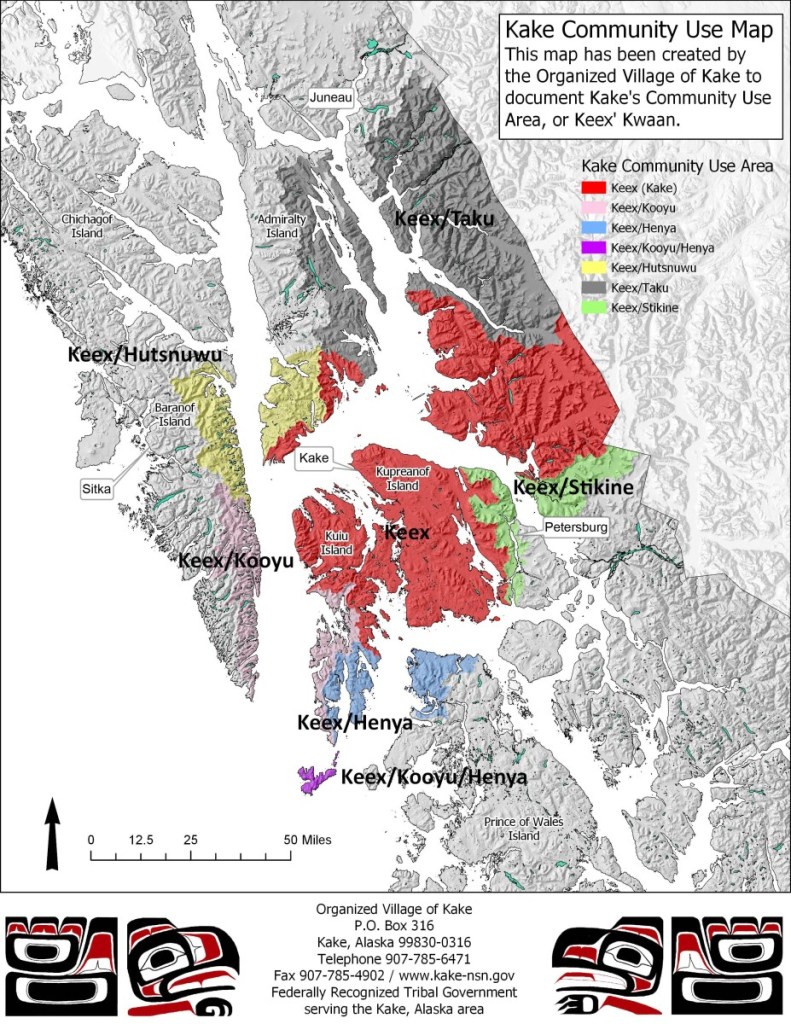
Kake is situated in the heart of Southeast Alaska, at the confluence of three major bodies of water: Frederick Sound, Chatham Strait, and Keku Strait. The Tribe, tribal corporation and community in Kake are concerned about how the saltwater and freshwater environments surrounding their traditional food harvesting areas are impacted by global climate change and by pollution.
The Kake Climate Partnership aims to produce tangible benefits for residents through co-produced climate research that strengthens food sovereignty and food security in the Kake Community Use Area. Former ACCAP postdoctoral fellow Dr. Elizabeth Figus is a founding member of the Kake Climate Partnership, which was formed in 2020 between the Organized Village of Kake, Kake Tribal Corporation, the City of Kake, and ACCAP.
The Kake Climate Partnership supports locally-led environmental monitoring and restoration projects that blend baseline climate and pollutant data collection with documenting local observations of environmental change over time.
Partners created a set of explicit principles and expectations to guide the work of the Partnership. The Principles and Expectations document stipulates broad ideas (e.g., shared values among partners) and narrowly defined responsibilities (e.g., who is responsible for record-keeping). Workforce development is a top priority of the Kake Climate Partnership, so all field projects are centered around paid work opportunities, mentorship, and training for local residents and Tribal citizens.
Between 2023 and 2025, this work was expanded through funding by the USGS Alaska Climate Adaptation Science Center (AK CASC). Now a private consultant, Dr. Figus continues to work with the Kake Climate Partnership on subsistence food security. Using CASC funding, Dr. Figus partnered with Hoonah Indian Association to co-produce climate adaptation work and expand regional capacity. CASC funding supported work in Hoonah relating to landslide risk assessment and impacts of atmospheric rivers on traditional shellfish beds. CASC funding also helped our teams advance the science of the evaluation of climate co-produced research and creation of a practical guidance framework for implementing co-production research, regional networking, and capacity building that can be applied and tested in meeting climate adaptation challenges related to research and planning in rural communities in other regions (Ellam Yua et al., 2022).
Next steps
After the close of the AK CASC project, Dr. Figus, Hoonah Indian Association, and the Kake Climate Partnership began collaborating around restoring herring populations near Hoonah and Kake. The Kake Climate Partnership continues work on climate services projects (including writing a Climate Adaptation Plan) and occasionally collaborates with ACCAP.
Funding
Dr. Figus has been funded by ACCAP NOAA RISA award NA16OAR4310162, USDA National Institute of Food and Agriculture (NIFA) Hatch project 1018914, and USGS Climate Adaptation Science Center (CASC) G22AC00604. The views and conclusions contained on this page are those of the authors and should not be interpreted as representing the opinions or policies of the U.S. Geological Survey. Mention of trade names or commercial products does not constitute their endorsement by the Alaska Climate Adaptation Science Center or the National Climate Adaptation Science Center or the U.S. Geological Survey. This website is made available with the understanding that the United States Government is authorized to reproduce and distribute reprints for Governmental purposes.
The Kake Climate Partnership has been supported by the following funding sources: ACCAP award NA16OAR4310162; USDA NIFA Hatch project 1018914; USGS Climate Adaptation Science Center (CASC) G22AC00604; EPA Indian General Assistance Program (IGAP; CFDA 66.926) at the Organized Village of Kake (OVK); Bureau of Indian Affairs Tribal Resilience Ocean and Coastal Management Planning Grant (#A20AP00144, held by OVK); NOAA Sea Grant Community Engaged Internship program; NOAA Hollings Preparation Program; and UAF Undergraduate Research and Scholarly Activity program.
The Kake Climate Partnership has also been supported by donations of time from: the Organized Village of Kake; the Kake Tribal Corporation; the City of Kake; the Alaska Youth Stewards program (funded through the United States Forest Service, the Sustainable Southeast Partnership, and SEALASKA Corporation).